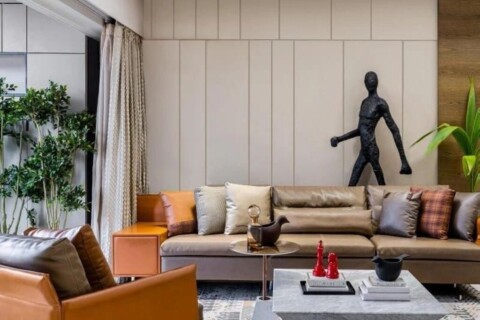
American video game publisher 2K commissioned ACDF to design its new Cloud Chamber office in Montreal.
ACDF came up with an innovative design that was more akin to a boutique hotel than a tech headquarters when the American video game publisher 2K asked the local company to design its Montreal office. The project is a wonderful illustration of how ACDF reimagines the atmosphere of specific programs, such as offices, and injects traditional elements with emotion without going overboard.
2K wanted an office for its Cloud Chamber studio that stood out from the crowd because Montreal is a hub for gaming companies. ACDF’s initial idea was to play with proportions, sightlines, and a monochromatic color scheme, drawing inspiration from residential architecture from the mid-century period. ACDF has created dimly lit areas throughout the 30,000-square-foot space that can accommodate over 150 people, responding to a very specific work environment for developers.
Other nooks, flooded with light, resemble garden cafes and outdoor terraces. The collection of various atmospheres, ranging from the more private to the more public, is combined into a single, cohesive design.
The office is on the fifth floor of a recently renovated former bank credit card company’s data center in the city’s Westmount neighborhood. The adaptive reuse office is inspired by the juxtaposition of calming darkness and energizing light. ACDF divided the space into brighter areas with white ceilings that convey openness and collaboration, and darker, intimate areas for focused, independent work.
The open floor plan is arranged in accordance with this principle into clusters, with a distinct zone designated for each of 2K’s teams. Each team has its own dedicated open area for individual work, characterized by furniture that corresponds with the muted colors of carpeting in their small offices and meeting spaces.
To create bright collaborative “gardens” for each team, ACDF worked with the building’s windows that pop out from the façade. “We took advantage of the building’s three-dimensional envelope and used its natural nooks to differentiate between zones,” said ACDF partner Joan Renaud. The gardens are equipped with wood decking, black metal structures, supports for writing boards and hanging plants, and white curtains that can be opened or closed depending on the desired level of privacy.
ACDF used the spaces between existing structures and closed central volumes to create non-linear circulation with moments that encourage interaction and foster a sense of team spirit rather than adding traditional walls to divide the floor plate. A series of internal units, from utility areas to elevator shafts, are wrapped in a warm palette of copper, wood, and tinted glass, bringing them all together visually. These volumes, which also house private offices, an entryway, a front desk, and coat storage for Montreal’s chilly winters, bring order and rhythm to the sea of open desks. The various lighting techniques, ranging from backlit tensile to exposed ductwork, give the impression that there are ceilings everywhere. Cabinetry made of pale oak, polished concrete floors, and minimalist but elegant furniture contribute to the space’s retro-futuristic vibe.
Post the pandemic, many employers and building owners are looking for ways to make workplaces more appealing. In an attempt to do so, ACDF has created a welcoming and inspiring environment by using high-quality materials and thoughtful detailing. It has balanced larger areas for group work and socialization with private spaces that offer the comfort of home, allowing employees to fully concentrate on work. The project provides a location where teams and employees can find what they need at any time while also promoting community and teamwork.
Photo Courtesy: Maxime Brouillet
Connect Online: www.acdf.ca