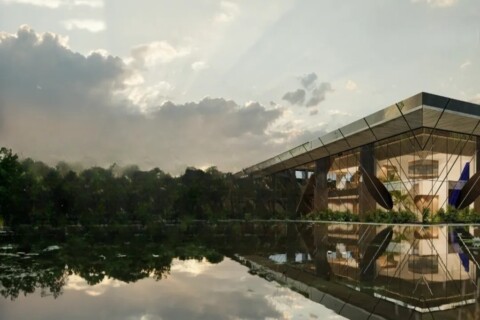
A contemporary expression of Qatari culture resonates in the new ROOM XIX at United Nations of Geneva
Photo Courtesy: Giovanna Silva and Peia
Almost a decade earlier, Qatar was responsible for the Italian makeover in the London skyline when they chose Renzo Piano to design The Shard Tower in London. Years later, when Qatar decided to etch its cultural values at the UN building in Geneva, yet again the role of an Italian firm, Peia Associati, came to the fore. The firm is managed by Partners Giampiero Peia and Marta Nasazzi.
The United Nations Office at Geneva is the second – largest of the four major office sites of the United Nations. The building consists of numerous rooms and halls managed by member nations of the UN. Recently, the XIX Hall in this building, located at the Palais des Nations, was completely renewed. Christened as The Hall of Qatar – The Multilateralism Hall, this project, funded by the State of Qatar, was commissioned to PEIA, an Italian architectural firm based in Milan.
Using a concentric and radial circular design, the designers have made a symbolic reference to equality – one of the key ideals the UN stands for. At the same time, the hall has been designed to reference the culture of Qatar. The design team presented to the UN a contemporary interpretation of Islamic calligraphy, devoid of religious affiliation, aligning with the secular credentials of the UN. This interpretation, also inspired by matrices and geometric patterns (musharabya), can be seen in various project components such as perforated wooden acoustic panels, bronze grids, fabrics, rugs, and custom – made porcelain mosaics.
The room is equipped with high – definition screens, a state – of – the – art lighting system, and the largest 4K LED wall, guaranteeing the highest technological standards for communication. The 400 individual audio and video monitors are equipped with advanced translation systems, providing a sophisticated platform for dialogue exchange between nations.
The ceiling of Room XIX, designed using Wood Skin, was partly inspired by the dunes of the desert. The sinuous lines are divided into triangles, a recurring geometry for optimizing complex surfaces. The Wood Skin team, drawing from Qatar’s cultural heritage, worked closely with the architects through multiple iterations to create the final pattern adorning the room.
While the ceiling recalls the movement of sand dunes and the lighting reflects the circadian rhythm of sunrise and sunset, the panels form “waves” that adapt to the acoustics of the circular space – symbolizing the UN’s mission to promote peaceful and diplomatic resolutions. This was achieved using 7,000 thin wooden eco – panels, aggregated with Wood Skin Inside technology, enabling fine – tuned acoustic management. The panels cover the original wooden walls, preserved within as a respectful “archaeological stratification” of heritage.
For the first time ever, an innovative lighting system was installed in a conference room to enhance comfort for UN delegates during long meetings. Using the circadian lighting system, the room transitions through different light scenarios that mimic natural daylight cycles, emphasizing the sculptural ceiling. Additionally, a motorized opening system offers views of the park, Lake Geneva, and Mont Blanc – not only as a pleasant backdrop but also as a reminder of environmental crises, including melting glaciers and polar ice, monitored by the UN.
The new Hall has a capacity of 800 seats, including 320 seats and desks for state delegates, an equal number for assistants, plus space for observers and the press. At 4,000 square meters, it is the largest and most technologically advanced plenary hall of the UN.
Connect Online @ www.peiaassociati.it